
More Information
Submitted: March 11, 2026 | Accepted: March 30, 2026 | Published: March 31, 2026
Citation: Chanda V. Factors Influencing Uptake of Iron Supplementation for 90+days During Pregnancy in Zambia. Clin J Obstet Gynecol. 2026; 9(1): 021-026. Available from:
https://dx.doi.org/10.29328/journal.cjog.1001202
DOI: 10.29328/journal.cjog.1001202
Copyright license: © 2026 Chanda V. This is an open access article distributed under the Creative Commons Attribution License, which permits unrestricted use, distribution, and reproduction in any medium, provided the original work is properly cited.
Keywords: Iron supplementation; Pregnancy nutrition; Maternal health; Iron deficiency anemia; Antenatal care; Micronutrient supplementation; Demographic health survey; Public health nutrition

Factors Influencing Uptake of Iron Supplementation for 90+days During Pregnancy in Zambia
Vee Chanda*
The University of Zambia, Lusaka, Zambia
*Corresponding author: Vee Chanda, The University of Zambia, Lusaka, Zambia, Email: [email protected]
Introduction: The uptake of iron supplements during pregnancy is a critical aspect of maternal health, particularly in regions where anemia and iron deficiency are prevalent. The study aimed to assess the factors influencing uptake of iron supplementation for 90 or more days among pregnant women in Zambia.
Methods: This research employed a cross-sectional design using data from the 2018 Zambia Demographic and Health Survey (ZDHS) individual (woman) record file. The inclusion criteria considered women 15-49 years who had a child in the five years preceding the survey. The dependent variable was iron supplementation for 90 or more days during the most recent pregnancy.
Results: The study found that education was a critical factor in improving adherence to iron supplementation, results revealed that women with higher education had the highest uptake of iron supplementation for 90 or more days (62.1%), while those with no formal education had the lowest (45.8%). The association between There were significant provincial variations in iron supplementation uptake (p < 0.001).
Conclusion: The findings of this study highlighted the importance of education in improving iron supplementation uptake among pregnant women in Zambia. The results can inform evidence-based interventions to improve maternal and child health outcomes. Policymakers and healthcare providers should prioritize education as a key factor in improving iron supplementation uptake.
1.1 Background
Iron deficiency anemia was a common nutritional disorder among pregnant women worldwide, including in Zambia. Iron is an essential mineral that helps produce red blood cells and transport oxygen in the body. Iron deficiency refers to a condition where the body does not have enough iron, an essential mineral that helps produce red blood cells and transport oxygen. Iron deficiency anemia occurs when the body does not have enough iron to produce adequate red blood cells, leading to symptoms such as skin, and shortness of breath (World Health Organization, 2020).
In Zambia, iron deficiency anemia is a significant public health concern, with studies indicating that a lot of pregnant women may be affected [1]. The high prevalence of iron deficiency by 76% anemia among pregnant women in Zambia highlights the urgent need for effective interventions to improve iron supplementation uptake and ultimately improve health outcomes for pregnant women and their babies in Zambia.
Globally, iron deficiency anemia is a major public health concern, with the World Health Organization (WHO) estimating that approximately 37% of pregnant women worldwide suffer from anemia, with iron deficiency being the most common cause (WHO, 2023).
This study aimed to investigate the factors influencing iron supplementation uptake among pregnant women in Zambia using a secondary analysis of the 2018 ZDHS, Understanding these factors is crucial for designing effective interventions to improve iron supplementation.
Previous studies by moyo, et al. have shown varying results regarding the prevalence of iron supplementation among pregnant women in Zambia, Africa, and globally. According The national health Institute The global prevalence approximately 2 billion people worldwide are affected by iron deficiency, with pregnant women being a high risk group. About 38% of pregnant women age 15-49 years are anemic globally, with higher rates in sub-Saharan Africa 56% compared to high-income countries 22% iron demand increases three fold during pregnancy, (National health institute 2023).
Anemia has been defined by the WHO (2021) as a low hemoglobin concentration in the blood, accompanied by depleted iron stores and signs of a compromised supply of iron to the tissues. Furthermore according to the WHO 2021 “it was said that system leading to an increase in susceptibility to infections and worsening treatment outcomes country where anemia in pregnancy is the most common cause of death among women in child bearing age and a high burden of infectious diseases.” Most African countries including Zambia have adopted the universal iron supplementation programmes since 2001 with expectations of prevention of anemia including iron deficiency anemia [2].
This study aimed to investigate the factors influencing uptake of iron supplementation for 90 or more days during pregnancy in Zambia using a secondary analysis of the 2018 Zambia Demographic and Health Survey (ZDHS). Understanding these factors is crucial for designing effective interventions to improve iron supplementation.
1.2 Statement of the problem
Pregnancy increases the demand for iron due to the expansion of blood volume and the needs of the growing fetus. Despite the importance of iron for preventing anemia and promoting healthy fetal development, the uptake of iron supplements among pregnant women in Zambia remains suboptimal. The 2018 ZDHS shows that 73% of pregnant women took iron supplements for 90+ days. This study aimed to investigate the factors influencing the uptake of iron supplements during pregnancy among women in Zambia, with the goal of improving maternal and the importance of iron supplementation for pregnant women and interventions have been made to improve the uptake of iron supplementation among pregnant women such as the scaling up nutrition movement committed to reducing prevalence of anemia [3,4].
1.3 Study rationale
Iron deficiency in pregnant women has been a major contributing factor to several health challenges such as preterm birth, low birth weight and increased maternal mortality .In order to curb iron deficiency in pregnant women, it is necessary to understand the factors associated with tithe findings from this study might be useful to identify important factors that implementers and planners can use to strengthen iron supplementation services and to educate pregnant women on the importance of iron supplement uptake and strengthening access during antenatal care visits. Also, the study was a requirement for the undergraduate degree in demography as it helps in gaining a deeper understanding of the relationships between health, nutrition and demographic outcomes, ultimately enhancing research skill [5-7].
1.4 Research objectives
1.4.1 General objective: To establish factors influencing uptake of iron supplementation for 90+ day’s uptake among pregnant women in Zambia.
1.4.2 Specific objectives: i. To determine the socio-economic factors associated with uptake of iron supplementation uptake for 90+ days among pregnant women in Zambia. ii. To investigate the demographic factors associated with uptake of iron supplementation uptake for 90+ days among pregnant women in Zambia.
1.5 Research question
What are the factors influencing the uptake of iron supplementation for 90+ days among pregnant women in Zambia?
2.1 Empirical review
The uptake of iron deficiency among pregnant women has caused great concern to most governments and organizations. This chapter provides insight to previous studies related to the topic under study on factors affecting iron supplementation uptake among pregnant women. These factors are categorized as demographic and socio-economic factors.
In Zambia, Simuyemba, et al. 2020 [8] conducted a root cause analysis in seven districts of Zambia, highlighting sub-optimal uptake and compliance to iron and folic acid supplementation, studies that have been conducted on the factors influcincing iron supplementation among pregnant women in Zambia along with their aim and findings, These studies are based on peer reviewed research and public health reports, and they provide valuable insights into the challenges and opportunities in improving iron supplementation coverage and adherence in the country, in a Study by Mwangalwe, et al. [1] .Factors Influencing Iron Supplementation Among Pregnant Women in Copperbelt Province which focused on women age 15 to 49 years old, the aim of this study was to assess the factors that influence the uptake and adherence to iron supplementation among pregnant women in Copperbelt Province, Zambia. The key findings included socioeconomic status, education level, health facility accessibility and health worker attitudes. Women with lower education levels and limited financial resources were less likely to take iron supplements.
Another similar Study by Moyo, et al. (2020) tilted Determinants of Iron Supplementation Uptake among Pregnant Women in Southern Province, Zambia, which aimed to determine the determinants of iron supplementation uptake among pregnant women in the Southern Province of Zambia. This study also focused on women in the reproductive age this study found that education levels, health and facility accessibility were the causes of women in this province as to why they did not adhere to iron supplements, another finding they found was that women with higher education levels were more likely to take iron supplements and have regular antenatal care visits which were associated with higher rates of iron supplementation.
In Africa yibeltal Bekele, et al. [9] did a similar study finding that iron supplementation during pregnancy has a positive impact on reducing perinatal death. However, evidence is insufficient to assess the relationship between iron-only and iron supplementation with adverse birth outcomes stillbirths, and neonatal mortality. East Africa Nanati Legese Alemu, et al. [10] found that adherence to iron and folic acid supplementation is crucial for preventing anemia and birth defects. Their study analyzed demographic and health surveys from nine East African countries. The study aimed at accessing the factors that add to pregnant women taking iron.
Siekmans, et al. Identified barriers and enablers for iron folic acid supplementation in pregnant women, including limited access to healthcare services, inadequate counseling, and challenges in adhering to supplementation schedules. Studies by Siekmans have shown that limited access to healthcare services, poverty, and lack of education are significant barriers to iron supplementation uptake among pregnant women. A study conducted by Dr Yaw in 2019 [11] found that iron supplementation during pregnancy resulted in higher hemoglobin levels and lower ferritin levels in the mother at the time of delivery. The study also found that iron supplementation reduced the risk of iron deficiency anemia during pregnancy. A study published in the Journal of Tropical Pediatrics in 2018 by Dr Sadankwa found that iron supplementation during pregnancy resulted in higher hemoglobin levels and lower ferritin levels in the mother at the time of delivery. The study was conducted in Ghana and included 200 pregnant women who were randomly assigned to receive either iron supplements.
Uptake of Iron supplementation is a common problem among pregnant women in Zambia, and iron supplementation is important for improving iron status and reducing the risk of anemia Barriers to iron supplementation uptake among pregnant women in Zambia include lack of knowledge about the importance of iron during pregnancy, lack of access to iron supplements, and high cost of supplements. Iron supplementation is associated with a reduction in the risk of anemia and preterm delivery among pregnant women in Zambia. The barriers to iron supplementation uptake among pregnant women in Zambia, and more studies are needed to identify the specific factors that contribute to low supplementation rates.
2.2 Theoretical framework/model
The Health Belief Model (HBM) was developed in the 1950s by Irwin Rosenstock Initially applied it to understand preventive health behaviors later expanded by Marshall Becker and others. The HBM has undergone revisions, incorporating new components like self-efficacy. It remains a widely used framework for understanding health behaviors and developing interventions. The Health Belief Model (HBM) can explain factors influencing uptake of iron supplementation among pregnant women by considering Pregnant women's beliefs about their risk of iron deficiency or anemia. Their understanding of the consequences of iron deficiency or anemia on their health and the fetus. Beliefs about the benefits of iron supplementation in preventing or treating anemia. Obstacles to taking iron supplements, such as side effects, cost, or accessibility.
Poorer women tend to adhere more to iron supplementation, possibly due to perceived need. Age doesn't significantly impact iron supplementation uptake. Educated women, especially those with primary or higher education, are more likely to adhere to iron supplementation due to better understanding and access to health information. These factors can influence pregnant women's ability to access and utilize iron supplements, ultimately affecting their health outcomes.
2.3 Definition of variables
Table 1.1 shows the variables and their definition.
| Table 1.1: Shows the variables and their definition | ||
| Variable | Definition | Response |
| Iron supplementation | Refers to the intake of iron supplements | no Yes |
| Age | Refers to chronological number measured in years | 15 to 49 |
| Education level | Level of formal education completed | No education Higher Secondary Primary |
| Residence | Place of residence | Rural Urban |
| Province | geographical division within Zambian | Lusaka Eastern Copper belt Northern Southern Western |
| Wealth status | Measure of socioeconomic status | Poorest Poorer Middle Richer Richest |
| TV exposure: your health matters | watching TV health programs | Yes No |
| Newspaper/magazine readership | Frequency of reading the newspaper | Not at all Less than a week Once a week Almost everyday |
| Parity | Children ever born | 1,2,34,5,6…. |
Figure 1.1: Conceptual framework on factors influencing Uptake of iron supplementation for 90+ days among pregnant women in Zambia.
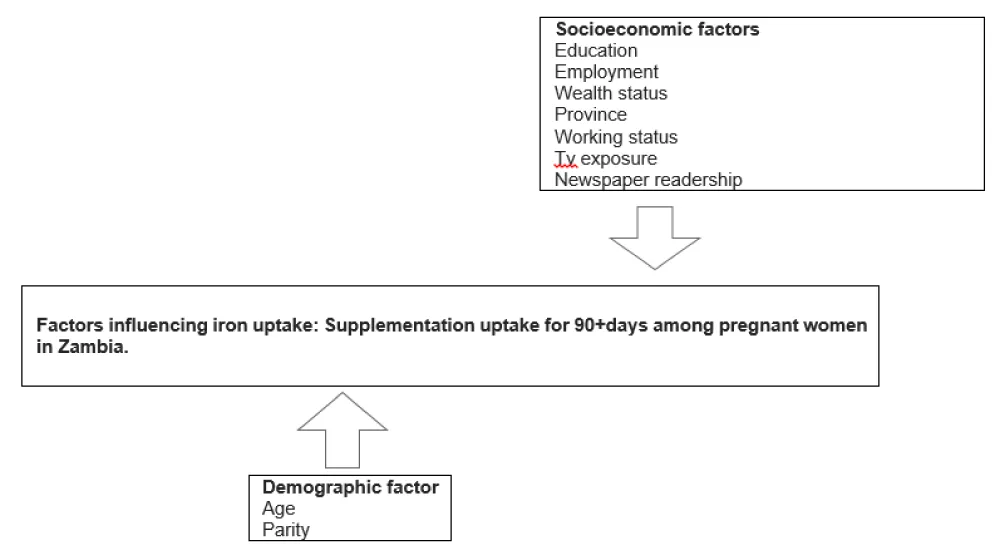
Figure 1: Conceptual framework on factors influencing Uptake of iron supplementation for 90+ days among pregnant women in Zambia.
3.1 Research design
The research design, methods, and procedures that were used to achieve the research objectives. The study used data from the Zambia Demographic Health Survey (ZDHS) conducted in 2018. The ZDHS was a cross-sectional study that used a two-stage stratified cluster sample design. This study used an explanatory design based on the positivist approach of understanding the prevalence uptake for iron supplements. This study is a quantitative research that aimed at determining the relationship between the dependent and independent variables of iron supplement uptake among pregnant women.
3.2 Data source
This research used secondary data from the Zambia Demographic Health Survey 2018 ZDHS in the individual record file, which contains data on individual respondents, including women of reproductive age. The women's data helped provide information on demographic and socioeconomic factors affecting the prevalence of iron supplementation uptake among pregnant women. This data was used to obtain factors associated with the prevalence of iron supplement uptake among pregnant women in Zambia. The data set was strictly used for its intended purpose.
3.3 Study area
The Study was conducted in Zambia, a country located in southern Africa. Zambia has a total population of approximately 20 million people, with a fertility rate of 5.3 children per woman (ZDHS, 2018).
This research was focused on women aged 15 to 49 years old and using data from the 2018 ZDHS in the individual file record. The study took place in Zambia, a landlocked country located in Southern Africa.
3.4 Sampling design and size
The sample size of this study was 7147 out of a total of 13625 who were surveyed. The ZDHS used a two-stage sampling design where the first stage involved selecting clusters or enumeration areas from a sampling frame, and the second stage involved selecting households from these clusters.
3.5 Study variable
A dependent variable is the iron supplementation uptake for 90+ days during pregnancy, which was generated as a dichotomous variable. One category coded “1” for pregnant women taking iron supplements for 90+ days, and the other category coded “0” for pregnant women not taking iron supplements. The independent variables are province, age of women, education, wealth, residence, and employment status.
3.6 Data analysis
Descriptive analysis and chi-square test results techniques were employed to achieve the research objectives. While descriptive analysis revealed the percent distributions of variables. Chi-square tests of independence were conducted for categorical variables, and significant differences were determined using chi-square. This analysis was conducted using software called Stata.
3.7 Ethical consideration
This study used secondary data, and this data was used mainly for research purposes. The data was confidential no names were used in this dataset.
3.8 Limitations and strengths of the study
A cross-sectional design limits the ability to establish causality. Secondary data analysis may be subject to biases and limitations of the original data. Findings may not apply to other populations or settings. The study's results may not be generalizable to other contexts.
The study on factors influencing the uptake of iron supplementation among pregnant women in Zambia had several strengths. Firstly, it used a nationally representative sample from the 2018 Zambia Demographic and Health Survey (ZDHS), allowing for generalizability of the findings to the broader population. The large sample size provides sufficient statistical power to detect significant associations between variables.
Table 4.1 frequency and percentage distribution of women by socioeconomic and demographic characteristics, this table shows results by distribution of women by various characteristics were in the age group 20 to 24 had the highest population of 1840 women who take iron supplements during pregnancy, while women in rural areas had the highest distribution of about 4786 of women who had the uptake of iron supplementation during pregnancy.
| Table 4.1: Frequency and percentage distribution of women by socioeconomic and demographic characteristics. | ||
| Characteristics | Frequency | Percentage |
| Age | ||
| 15-19 | 720 | 10.07 |
| 20-24 | 1840 | 25.75 |
| 25-29 | 1592 | 22.28 |
| 30-34 | 1340 | 18.75 |
| 35-39 | 977 | 13.67 |
| 40-44 | 524 | 7.33 |
| 45-49 | 155 | 2.15 |
| Residence | ||
| Urban | 2361 | 33.03 |
| Rural | 4786 | 66.97 |
| Province | ||
| Central | 720 | 10.07 |
| Copperlbelt | 720 | 10.07 |
| Eastern | 885 | 12.39 |
| Luapula | 782 | 10.94 |
| Lusaka | 810 | 11.34 |
| Muchinga | 626 | 8.76 |
| Northern | 674 | 9.43 |
| North western | 588 | 8.23 |
| Southern | 734 | 10.27 |
| Western | 608 | 8.51 |
| Educator level | ||
| No education | 667 | 9.36 |
| Primary | 3603 | 50.4 |
| Secondary | 2550 | 35.7 |
| Higher | 325 | 4.55 |
| Wealth status | ||
| Poorest | 1823 | 25.51 |
| Poorer | 1642 | 22.97 |
| Middle | 1442 | 20.29 |
| Richer | 1173 | 16.41 |
| Richest | 1059 | 14.82 |
| TV exposure: your health matters | ||
| No | 6487 | 10.72 |
| Yes | 660 | 9.23 |
| Newspaper/ magazine readership | ||
| Not at all | 6018 | 82.63 |
| Less than a week | 624 | 9.03 |
| At least once a week | 381 | 5.52 |
| Almost every day | 124 | 1.79 |
| Working status | ||
| No | 3704 | 51.8 |
| Yes | 3443 | 48.2 |
| Parity | ||
| 01-Feb | 3083 | 43.1 |
| 03-Apr | 1943 | 27.2 |
| 5+ | 2121 | 29.7 |
| TOTAL | 7149 | 100 |
Table 4.2 shows Chi-square test results showing significant associations between iron supplementation and province, education level, exposure to health-related media (TV and newspapers), and frequency of reading newspapers or magazines (p < 0.05). Other characteristics such as age group, type of residence, wealth index, parity, and current working status were not significantly associated with iron supplementation uptake.
| Table 4.2: Percentage distribution of women's background characteristics by adherence to iron supplementation uptakes. | |||
| Background characteristics | Iron supplementation | p - value | |
| No% | Yes% | ||
| Age | |||
| 15_19 | 193(26.81) | 527(83.9) | 0.288 |
| 20_24 | 484(28.30) | 1356(73.70 | |
| 25_29 | 450(28.27) | 1142(7173) | |
| 30_34 | 350(26.12) | 990(73.88) | |
| 35_39 | 247(25.28) | 730(74.72) | |
| 40_44 | 137(76.15) | 387(73.85) | |
| 45_49 | 52(33.77) | 102.(66.23) | |
| Risdence | |||
| Urban | 649 (27.49) | 1,712 (72.51) | 0.333 |
| Rural | 1264(26.41) | 3522(73.59) | |
| Province | |||
| Central | 178 (24.72) | 542(75.28) | 0.001 |
| Copper belt | 177(24.58) | 543(75.43) | |
| Eastern | 222(22.08) | 667(74.92) | |
| Luapula | 361(46.16) | 421(53.84) | |
| Lusaka | 168(20.74) | 642(79.26) | |
| Muchinga | 104(20.74) | 522(83.39) | |
| Northern | 145(21.51) | 529(78.49) | |
| North western | 71(12.07) | 517(87.43) | |
| Southern | 241(32.83) | 493(67.17) | |
| Western | 246(40.46). | 3.62(59.54) | |
| Working status | |||
| No | 1004(27.10) | 2701(72.90) | 0.511 |
| Yes | 909(24.4) | 2533 ( 73.90) | |
| Education level | |||
| No education | 204(30.49) | 465(69.51) | 0.001 |
| Primary | 1007(27.95) | 2596(72.05) | |
| Secondary | 647(25.37) | 1903(74.63) | |
| Higher | 55(16.92) | 270(83.08) | |
| Wealth quitle | |||
| Poorest | 512(28.09) | 1311(71.91) | 0.07 |
| Poorer | 446(27.16) | 1196(72.84) | |
| Poor | 389(26.83) | 1061(73.17) | |
| Richer | 320(27.28) | 853(72.72) | |
| Richest | 246(23.23) | 813(76.27) | |
| Tv exposure | |||
| No | 1784(27.50) | 4703(72.50) | 0.001 |
| Yes | 129(19.55) | 531(80.45) | |
| Newspaper readership | |||
| Not at all | 164(27.37) | 437(72.63) | 0.024 |
| Less than a week | 152(24.36) | 472(75.64) | |
| At least once a week | 92(24.15) | 289(75.85) | |
| Almost every day | 22(17.74) | 102(82.26) | |
| Parity | |||
| 01-Feb | 809(26.24). | 2274(73.76) | 0.071 |
| 03-Apr | 492(25.63). | 1443(74.38) | |
| 5+ | 607(28.58). | 1517(71.42) | |
| Iron supplementation for 90+days | No uptake | Yes uptake | |
| TOTAL | 1913 | 5234 | |
The results revealed that women with higher education had the highest uptake of iron supplementation (62.1%), while those with no formal education had the lowest (45.8%). The association between education and iron supplementation was statistically significant (p < 0.001).
There were significant provincial variations in iron supplementation uptake (p < 0.001).
This chapter discusses the findings of the study, highlighting the key determinants of iron supplementation uptake among pregnant women in Zambia. The study aimed to investigate socioeconomic and demographic factors influencing uptake of iron supplementation during pregnancy.
5.1 Socioeconomic factors influencing iron supplementation uptake among pregnant women in Zambia
The results revealed that women with higher education had the highest uptake of iron supplementation for 90 or more days (62.1%), while those with no formal education had the lowest (45.8%). The association between There were significant provincial variations in iron supplementation uptake (p < 0.001). Provinces such as Lusaka and Copperbelt recorded higher uptake of iron supplementation above 57% while Luapula, Western, and Eastern Provinces showed comparatively lower uptake below 50% these disparities may reflect variations in health service delivery, stock availability, infrastructure, and health promotion activities across provinces, The finding is consistent with studies by ministry of health 2021, which they found that education was a key factor in influencing uptake of iron during pregnancy.
Demographic factors influencing iron supplementation uptake among pregnant women in Zambia.
5.2 Conclusion
In conclusion, uptake of iron supplementation among pregnant women in Zambia is influenced by understanding the factors that influence uptake of iron supplementation. Healthcare providers and policymakers can develop targeted interventions to improve adherence and reduce the burden of iron deficiency anemia among pregnant women in Zambia.
5.3 Recommendations
i. Focus on educating Women Develop targeted education programs to improve women's knowledge about the importance of iron supplementation during pregnancy, particularly for those with low education levels.
ii. Ensure that all pregnant women receive comprehensive health information, including iron supplementation and health education, to improve iron supplementation uptake.
iii. Target Wealthier and Poorer Households Equally, Develop strategies to reach women from disadvantaged households and ensure equal access to iron supplements and ANC services.
- Mwangelwa, Moyo D. Medical Journal of Zambia. 2018. Available from: www.mjz.com
- Centers for Disease Control and Prevention. Available from: https://www.cdc.gov/index.html
- Kapambwe. BMC Pregnancy and Childbirth. 2019. Available from: https://www.biomedcentral.com/
- UNICEF. Anemia among women of reproductive age. Available from: https://www.unicef.zambia
- United Nations. Sustainable Development Goals. Available from: https://sdgs.un.org/goals
- World Health Organization. Worldwide prevalence of anaemia 1993–2005: WHO global database on anaemia. 2008. Available from: https://www.who.int/publications-detail-redirect/WHO-NMH-NHD-MNM-11.1
- Kamvuma K, Masenga S, Hamooya B, Chanda W, Munsaka S. Prevalence and factors associated with moderate-to-severe anaemia among virally suppressed people with HIV at a tertiary hospital in Zambia. 2024. Available from: https://doi.org/10.1371/journal.pone.0303734
- Lukundo S, Chishimba FL, Mukubesa C, Musonda M, Kabati F, Miyoba MH, et al. Prevalence and associated factors of anemia during pregnancy at a tertiary hospital in Zambia. 2025. Available from: https://doi.org/10.1371/journal.pone.0327801
- Bekele. International Journal of Environmental Research and Public Health. 2024. Available from: https://www.mdpi.com/journal/ijerph
- Alemu NL, Roba KT, Getaneh HD, Raru TB, Daba AK, Worku N, et al. Adherence to iron and folic acid supplementation and its determinants among pregnant women in East Africa. 2025. Available from: https://doi.org/10.1371/journal.pone.0327410
- African Journals. Dr Yaw. Available from: www.africanjounrnals.com